跳至主要内容

How to Choose Between Round Sling and Webbing Sling: Full Guide for Lifting Operators

 In lifting operations, choosing the right sling is just as crucial as selecting the proper crane, shackle, or hook. Among synthetic lifting slings, round slings and flat webbing slings are the two most common types used on construction sites, in factories, warehouses, and equipment installation projects.

Both are made of high-strength polyester fibers, offering light weight, flexibility, and ease of handling. They also comply with international standards such as EN 1492, AS 1353/AS 4497, and WSTDA specifications.

However, they differ significantly in structure, performance, ideal applications, durability, and safety characteristics. This article provides a comprehensive comparison of round slings versus flat webbing slings, helping you understand their differences and choose the right sling for your specific lifting needs.

Round Sling VS. Flat Webbing Sling

The most important and fundamental difference between these two sling types is their load-bearing structure.

Round Sling Construction
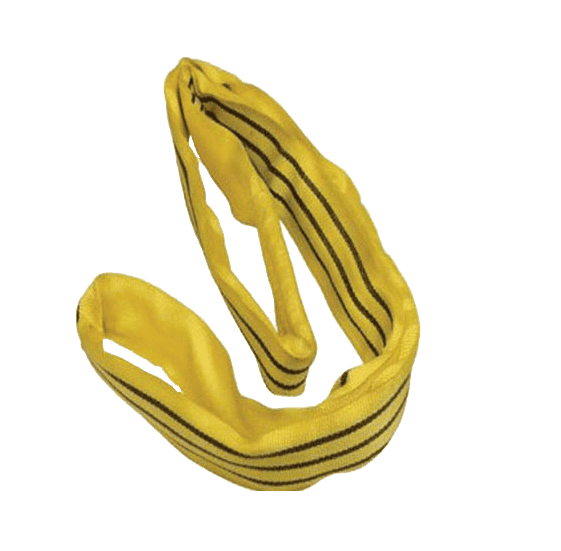
round sling
  • Inner core yarns bear the entire load.
  • The outer sleeve serves only as protection.
  • If the sleeve is damaged, the internal core might still be intact—but any sleeve tear must be treated as a serious warning.

Webbing Sling Construction
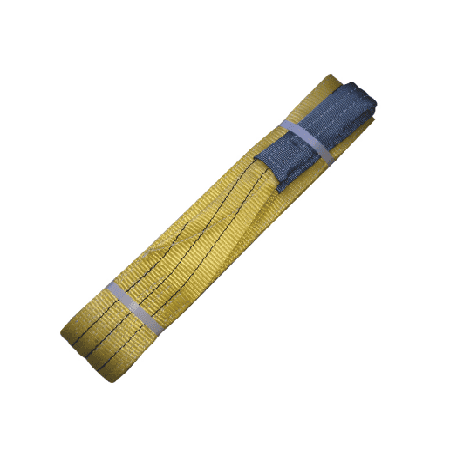
FLAT WEBBING SLING
  • The woven webbing body itself bears the load.
  • Reinforced eyes provide extra strength at the lifting points.
  • Wear and damage are visible on the surface, making inspection easier.

Strength, WLL, and Lifting Performance

Both sling types follow similar color-coded WLL systems (e.g., purple 1T, green 2T, yellow 3T). However, their performance under various lifting methods can differ.
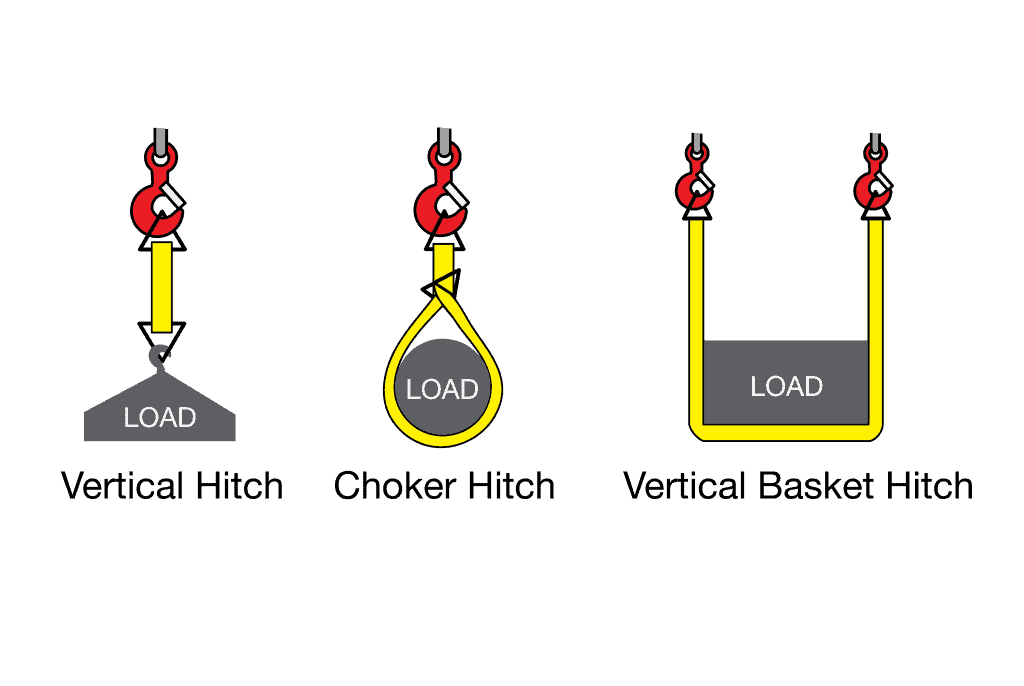
lifting hitches

Round Sling Advantages

  • Performs better in a choker (choke) hitch due to its circular shape.
  • Wraps tightly and evenly around pipes, tubes, and machines.
  • Lower risk of point loading.

Webbing Sling Advantages

  • Provides a wider contact surface, distributing pressure more evenly on flat objects.
  • Performs exceptionally well in a basket hitch, where the load is doubled.
  • Less rolling movement because of its flat shape.

How to Choose the Right Sling?

You should choose a round sling if:

  • The load has a curved or irregular shape
  • The surface must not be scratched
  • You frequently use the choker hitch

Choose a webbing sling if:

  • The load is flat, boxed, or wide
  • The sling may contact edges (with protectors)

A simple rule: Round sling for round objects; webbing sling for flat objects.

Final Thoughts

The choice between round slings and flat webbing slings often comes down to the task at hand. While both are indispensable in lifting operations, they each excel in specific situations. Round slings are valued for their flexibility and gentle handling of sensitive surfaces, while webbing slings stand out for their durability against abrasion, ease of inspection, and cost-effectiveness.

If your work regularly involves both flat and curved or irregular loads, it’s worth keeping both types on hand. That way, you’re always prepared with the right sling for the task.

评论

此博客中的热门博文

Australian Standard Webbing Slings & Round Slings |AS1353 & AS4497

  In the Australian market, lifting slings are essential tools in hoisting and material handling operations, and their safety and performance must comply with strict national standards. Australia’s lifting sling standards primarily include   AS 1353   and   AS 4497 , which apply to   webbing slings (flat slings)   and   roundslings , respectively. www.chinatoplifting.com tracy@chinatoplifting.com Overview of Applicable Standards Sling Type Standard Standard Title Webbing Sling AS 1353.1 / AS 1353.2 Flat synthetic webbing slings – Manufacture & Use Roundsling AS 4497.1 / AS 4497.2 Synthetic roundslings – Manufacture & Use Structure & Material Differences Webbing Slings Structure : Made from one or more layers of woven polyester webbing. Common designs include flat type, eye type, and reinforced eye type. Features : Lightweight and flexible Easy to store and fold Wide contact area to avoid damage to loads Compatible with corner protectors for...

A comprehensive guide to hand hydraulic pallet trucks

  In the world of modern logistics and warehousing, the   Hand Pallet Truck —also known as a manual pallet jack—is one of the most widely used and essential tools for material handling. Known for its simplicity, reliability, and cost-effectiveness, it plays a vital role in short-distance transportation across warehouses, factories, supermarkets, and more. What is a hand pallet truck? A  hand pallet truck  is a manually operated tool used to lift and move palletized loads. It typically consists of: Handle  – for steering and controlling the hydraulic pump. Hydraulic pump  – activated by pressing the handle up and down to raise or lower the forks. Fork arms  – slide into the base of a pallet and support the load. Wheels  – front and rear wheels made of materials like nylon, PU, or rubber, depending on the environment. Common Application Scenarios Due to its easy operation and versatility, the hand pallet truck is widely used in: Warehouses and stora...

Common Stitching Defects in Lifting Slings and How to Spot Them

  When it comes to  lifting slings , most buyers focus on the webbing material, the label, or the load capacity. However, one often-overlooked yet   critical component   is the   stitching . The stitching—specifically the sewing thread and pattern—plays a key role in the overall strength and durability of the sling. Why Stitching Matters in Lifting Slings The strength of a lifting sling doesn’t come from the webbing alone—it relies heavily on the quality of stitching that holds everything together. Poor stitching can significantly reduce the Working Load Limit (WLL) and may lead to dangerous failures during lifting operations. The stitching on a webbing sling isn’t just about holding layers together—it’s what keeps the sling strong and safe under load. If the stitching is poorly done, the entire sling becomes unreliable. Here’s what can go wrong: Lower Strength  – Weak stitching reduces the sling’s working load limit (WLL), meaning it might fail when you le...